Event Data Security and GDPR Compliance in Event Software
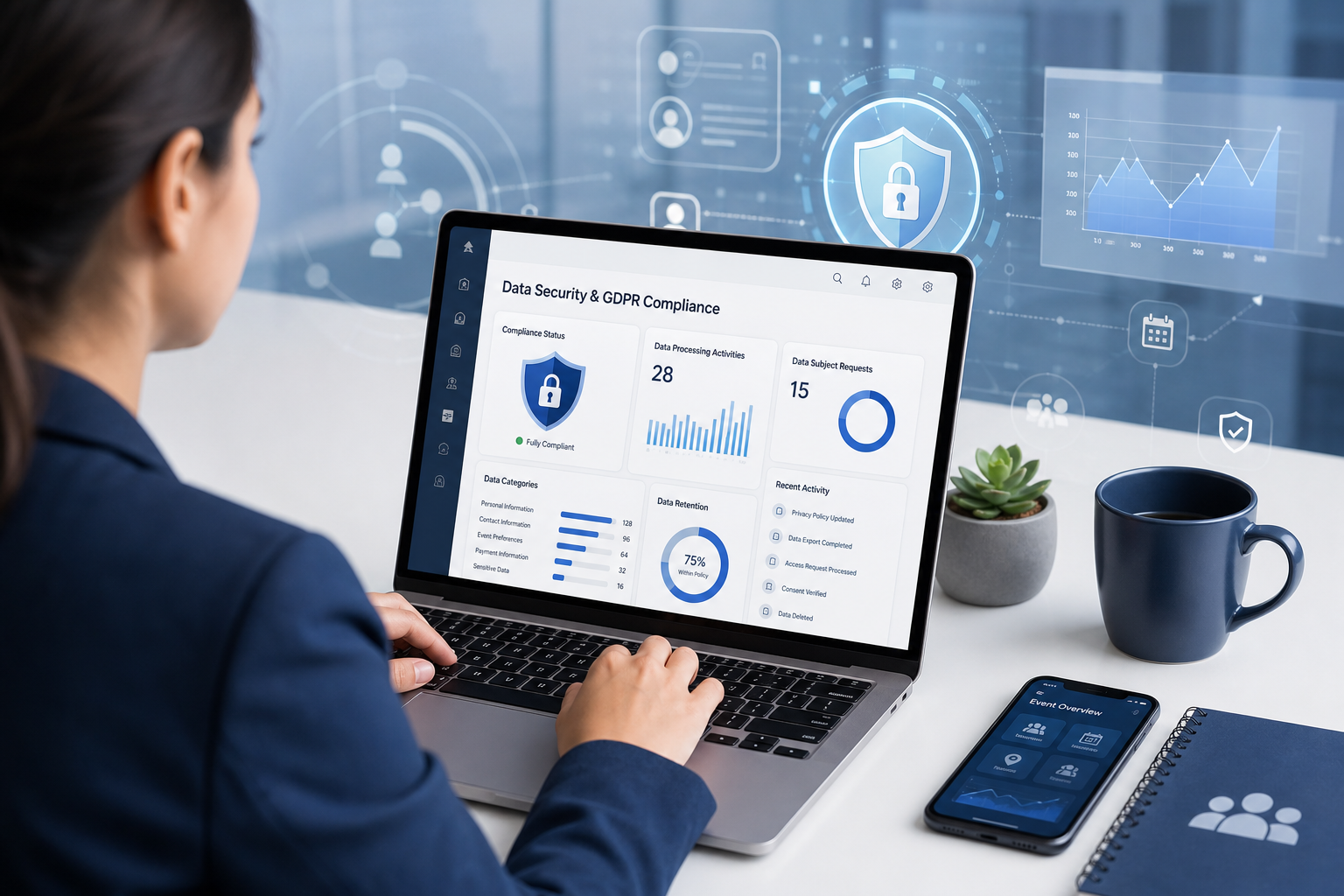
For professional event organizers, attendee trust is now as important as ticket sales, sponsor revenue, and on-site experience. Every registration form, mobile app login, badge scan, payment transaction, and post-event survey creates data that must be handled responsibly. That is why event data security and GDPR compliance should be central to any event technology buying decision.
Modern events collect a surprising amount of personal information: names, job titles, email addresses, phone numbers, dietary requirements, accessibility requests, session selections, networking preferences, location data, and sometimes payment details. If that information is exposed, mishandled, or retained without a lawful basis, the consequences can be serious. Event organizers may face reputational damage, attendee complaints, sponsor concerns, regulatory scrutiny, and financial penalties.
The good news is that the right platform can make data protection much easier. When evaluating tools, organizers should look beyond surface-level functionality and assess how a provider secures information, supports privacy rights, documents processing, and helps teams work in a compliant way. If you are comparing options, this event management software guide is a useful place to start alongside a detailed security review.
In this article, we will break down what GDPR means in practical event terms, why event software selection matters, and the exact security and privacy capabilities to look for before you commit to a platform.
Why attendee data protection matters more than ever
Event organizers operate in a high-data environment. A single event may involve registration systems, CRMs, email tools, payment gateways, badge printing vendors, mobile event apps, lead retrieval tools, streaming platforms, and sponsor portals. Each handoff increases complexity. Each integration creates another point of risk.
At the same time, attendees are more privacy-aware. They want to know what data is being collected, why it is needed, who can access it, and how long it will be kept. Enterprise clients and associations are also asking tougher due diligence questions before they approve event technology vendors.
Regulations have raised the bar too. The EU General Data Protection Regulation, or GDPR, remains one of the most influential privacy frameworks in the world. Even organizers outside Europe often need to account for it because they market to EU residents, host international events, or work with global clients who expect GDPR-grade controls. Other laws, such as the UK GDPR, CCPA and CPRA in California, and broader privacy reforms across multiple jurisdictions, have made privacy governance a standard business requirement rather than a niche legal issue.
Data protection is no longer just an IT concern. In event management, it affects registration strategy, attendee communications, sponsor activation, analytics, procurement, and brand reputation.
What GDPR means for event organizers
GDPR is a broad regulation, but event organizers do not need to become privacy lawyers to make better software decisions. What matters is understanding the principles that shape day-to-day event operations.
Lawful basis for collecting attendee data
You should be able to identify why you are collecting each type of data. In many event contexts, lawful bases may include contract performance, legitimate interests, legal obligation, or consent. For example, you may need contact details to process a registration, but you may need separate consent for certain marketing communications or attendee data sharing with sponsors.
Purpose limitation and data minimization
Collect only the information you genuinely need. If a field is not necessary for registration, service delivery, safety, accessibility, or a clearly defined business purpose, consider removing it. Good event platforms support customizable forms so you can avoid over-collecting data.
Transparency
Attendees must understand how their information will be used. Your event management software should make it easy to present privacy notices, consent language, preference options, and data-sharing disclosures at the right points in the user journey.
Security and confidentiality
GDPR requires appropriate technical and organizational measures to protect personal data. This is where software architecture, access controls, encryption, logging, and vendor practices become essential.
Data subject rights
Individuals may request access to their data, correction of inaccurate information, deletion in some cases, or restriction of processing. Your platform should help your team find, export, update, or erase attendee records efficiently.
Retention and deletion
Personal data should not be stored indefinitely without justification. Event software should support retention controls and practical deletion workflows once data is no longer required.
The risk of choosing software based on features alone
Many event teams focus first on registration flows, agenda management, check-in speed, engagement tools, and reporting dashboards. Those capabilities matter, but a polished front end does not guarantee secure or compliant operations behind the scenes.
A feature-rich platform can still create privacy problems if it lacks granular permissions, stores data in unclear locations, makes consent records hard to retrieve, or cannot separate sponsor lead sharing from attendee marketing preferences. Similarly, a low-cost tool can become expensive if your team must rely on manual workarounds to handle deletion requests, document consent, or restrict exports.
When reviewing vendors, evaluate security and compliance as core product capabilities, not as secondary legal checkboxes. A mature provider should be able to explain its controls clearly and confidently. You can also review broader platform capabilities on the features page and compare operational fit with your event program.
What to look for in event management software to protect attendee data
1. Strong access controls and user permissions
Not every team member, partner, exhibitor, or volunteer should have the same level of access. One of the most important safeguards in event software security is role-based access control.
Look for a platform that allows you to:
- Assign permissions by role, team, event, or function
- Restrict access to attendee lists, financial data, and reporting exports
- Limit sponsor or exhibitor visibility to only the leads they are entitled to receive
- Control who can edit forms, messaging templates, privacy notices, and integrations
- Require strong passwords and preferably support single sign-on or multi-factor authentication
The goal is simple: people should access only the data they need to do their job.
2. Encryption in transit and at rest
Ask vendors how they protect data when it is being transmitted and when it is stored. Reputable platforms should use encryption in transit, typically through TLS, and apply strong safeguards for stored data as well. Encryption alone is not enough to guarantee compliance, but it is a foundational control that reduces exposure if systems are intercepted or infrastructure is compromised.
Also ask how backups are protected and whether sensitive data fields receive additional safeguards.
3. Clear data hosting and subprocessor transparency
Where is attendee data stored? Who else can access it as part of service delivery? These are basic but critical questions. Event organizers should understand the vendor's hosting environment, whether data is processed in the EU or transferred internationally, and what contractual protections are in place.
Look for providers that can clearly explain:
- Primary hosting region and redundancy approach
- Whether data transfers outside the EEA occur
- Use of subprocessors such as cloud providers, email services, analytics vendors, or support tools
- Mechanisms used for international transfers where applicable
- How customers are notified of subprocessor changes
Transparency here is a sign of operational maturity.
4. Consent management and preference capture
Consent can be one of the trickiest areas in event operations, especially when marketing, networking, sponsor lead retrieval, and post-event follow-up overlap. Your software should support precise, auditable consent capture rather than relying on vague all-in-one checkboxes.
Useful capabilities include:
- Custom consent fields at registration
- Separate opt-ins for event updates, promotional marketing, and sponsor communications
- Time-stamped consent records
- Version tracking for privacy and consent language
- Easy updates to communication preferences
This level of granularity helps your team prove what an attendee agreed to and avoid overstepping the permissions granted.
5. Audit logs and activity monitoring
If attendee data is changed, exported, deleted, or shared, you should be able to see who did it and when. Audit logs support both security investigations and accountability. They are especially helpful for larger teams, agencies managing multiple clients, and events involving several stakeholders.
Ask whether the platform records:
- User logins and failed login attempts
- Changes to attendee records
- Data exports and bulk downloads
- Permission changes
- Consent updates
- Integration activity where relevant
Without strong visibility, it becomes much harder to investigate incidents or demonstrate responsible controls.
6. Data retention and deletion tools
Many event teams keep legacy attendee data far longer than necessary simply because deletion is inconvenient. That is risky. Good event management software should help you define retention periods and act on them in a controlled way.
Look for options to:
- Delete or anonymize attendee records after a defined period
- Apply different retention rules for registrants, no-shows, leads, and staff
- Remove data from backups according to documented policies
- Handle data subject deletion requests without breaking reporting integrity
Retention is one of the clearest areas where software can either simplify compliance or quietly undermine it.
7. Data subject request support
When an attendee asks for a copy of their data or requests correction or deletion, your team should not have to search five disconnected systems manually. The right platform makes these workflows manageable.
Ask vendors how they support:
- Exporting an individual's data in a usable format
- Correcting profile information
- Deleting or anonymizing records
- Documenting the request and response
- Coordinating requests across integrated systems
Even if requests are infrequent, your response process says a lot about operational resilience.
8. Secure integrations and API controls
Most event programs rely on integrations with CRM systems, marketing automation platforms, payment processors, badge printing tools, webinar platforms, and analytics products. Every connection is a potential exposure point if it is not properly secured and governed.
Look for:
- Documented API security practices
- Authentication methods for integrations
- Ability to restrict integration scopes and data flows
- Controls over which fields are shared
- Error logging and failed sync monitoring
It is not enough for the core platform to be secure if connected systems copy attendee data broadly without clear rules.
9. Incident response and breach notification readiness
No vendor can credibly promise that incidents will never happen. What matters is whether they have a mature process to detect, contain, investigate, and communicate issues quickly. GDPR includes strict expectations around breach response, so vendors should be able to explain their playbook.
Ask about:
- Security monitoring and alerting
- Incident response procedures
- Breach notification timelines and customer communication commitments
- Disaster recovery and business continuity planning
- Roles and responsibilities during an incident
A vague answer here is a warning sign.
10. Vendor documentation and contractual readiness
Reliable providers should be prepared to support procurement and legal review. That often includes a data processing agreement, security documentation, and answers to customer questionnaires.
Common items to request include:
- Data Processing Agreement (DPA)
- List of subprocessors
- Information security overview
- Retention and deletion policy summary
- Privacy support process for customer requests
- Any relevant third-party assessments or certifications if available
While certifications are helpful, they are not the whole story. A provider should also demonstrate practical controls that align with your event workflows.
Questions to ask vendors during software evaluation
To move from general promises to meaningful due diligence, build privacy and security questions into your selection process. Here are some practical examples:
- How do you secure attendee data at rest and in transit?
- Can we configure role-based permissions for internal teams, clients, sponsors, and exhibitors?
- How do you support GDPR rights requests, including export and deletion?
- Where is data hosted, and do you transfer personal data internationally?
- How is consent recorded, and can we separate marketing opt-ins from sponsor data sharing?
- What audit logs are available to customers?
- What is your incident response process, and how quickly will customers be notified of a breach?
- What data retention controls are built into the platform?
- Which subprocessors do you rely on, and how do you vet them?
- Can you provide a DPA and other compliance documentation during procurement?
These questions often reveal more than a sales demo ever will.
Operational best practices beyond the software itself
Even the best platform cannot compensate for weak internal processes. Protecting attendee data requires a combination of good technology, clear governance, and team training.
Limit what you collect
Review every registration field and ask whether it is necessary. Remove nice-to-have fields that create extra risk without delivering real value.
Review sponsor and exhibitor data-sharing rules
Lead retrieval and networking features can create privacy confusion fast. Be explicit about when attendee details are shared, under what legal basis, and how that is communicated.
Train your event team
Temporary staff, contractors, and volunteers may handle attendee data during peak event periods. They should understand secure login practices, device handling, phishing awareness, and rules for exporting or sharing attendee lists.
Document your workflows
Create internal procedures for privacy notices, consent setup, data access requests, incident escalation, and post-event retention review. Documentation reduces inconsistency and helps teams act quickly under pressure.
Run post-event data cleanup
After each event, review what data should be retained, archived, anonymized, or deleted. Do not let historical event records accumulate indefinitely just because storage is cheap.
Common red flags in event software evaluations
As you compare vendors, watch for warning signs that suggest privacy and security are not taken seriously:
- Vague answers about where data is hosted
- No clear DPA or resistance to security documentation requests
- All users sharing broad administrative access
- Limited or nonexistent audit trails
- Inflexible consent options or bundled opt-ins
- No practical deletion workflow for attendee records
- Unclear breach notification process
- Heavy reliance on manual workarounds for rights requests
If a platform creates uncertainty during procurement, it will likely create friction during live event delivery too.
How EventForge supports secure, privacy-conscious event operations
Professional event organizers need software that balances operational efficiency with responsible data handling. EventForge is built to help teams manage registrations, communications, attendee engagement, and reporting with the structure needed for modern privacy expectations.
Whether you are running conferences, trade shows, association meetings, or corporate events, choosing a platform with strong controls can reduce risk while improving team confidence. If you are assessing fit, explore EventForge's pricing options and compare what your team needs across different event types and volumes.
You can also browse more practical advice on the EventForge blog, where we cover event technology, attendee engagement, planning workflows, and operational best practices for organizers who need scalable systems.
Final checklist for choosing GDPR-ready event management software
Before making a final decision, confirm that your shortlisted platform can support the following:
- Role-based access controls and strong authentication
- Encryption in transit and at rest
- Transparent hosting and subprocessor disclosures
- Granular consent capture and preference management
- Audit logs for user actions and data exports
- Retention, deletion, and anonymization workflows
- Support for access, correction, and deletion requests
- Secure integrations with controllable data flows
- Documented incident response and breach notification procedures
- Contractual readiness including a DPA
That checklist will not replace legal advice, but it will help event professionals ask better questions and choose software that supports safer, more compliant event delivery.
Conclusion: protect attendee trust with the right platform
Attendee data is one of the most valuable assets in event operations, and one of the easiest to mishandle if systems and processes are not designed with privacy in mind. Choosing the right event management software is about more than convenience. It is about safeguarding trust, supporting compliance, and reducing operational risk across every stage of the event lifecycle.
When evaluating vendors, look beyond marketing claims and insist on practical proof: secure access controls, auditable consent records, retention tools, transparent documentation, and a credible incident response model. The right platform should help your team work smarter while respecting the privacy rights of every attendee.
If you are ready to modernize your event tech stack with security and compliance in mind, explore EventForge in more detail or start your EventForge trial. If you have specific security or privacy questions, our team is here to help through the contact page.
Frequently Asked Questions
Does GDPR apply to event organizers outside the EU?
It can. GDPR may apply if you offer events to people in the EU, market to EU residents, or process personal data connected to EU-based attendees. Many non-EU organizers also follow GDPR-style practices because enterprise clients and global audiences expect them.
What attendee data is considered personal data under GDPR?
Personal data can include names, email addresses, phone numbers, job titles, company names when linked to an individual, dietary needs, accessibility requests, IP addresses, location data, and networking preferences. If the data can identify a person directly or indirectly, treat it carefully.
What is the most important security feature in event management software?
There is no single feature, but role-based access control is one of the most important because it limits who can view, edit, export, or share attendee data. It should be combined with encryption, audit logs, consent tracking, and retention controls.
Should event organizers keep attendee data after the event ends?
Only if there is a clear, documented reason to do so. Retention should be tied to legitimate business, legal, or reporting needs. Event software should help you delete or anonymize data once it is no longer necessary.
How can event software help with GDPR rights requests?
A good platform should let teams locate a person's record quickly, export their data in a usable format, correct inaccurate details, and delete or anonymize records where appropriate. It should also help document the request and the response.
Ready to run better events?
Join event professionals using EventForge to plan, execute, and analyze events at scale.